
Candy Store Markdown Strategy: Decide What to Reduce, Test and Stop
Plan candy-store markdowns around eligible stock, a defined trial and a clear stop point, with practical checks for displays, checkout prices and remaining inventory.
Define the stock problem before changing a price
A retail markdown strategy sets out which products may receive a lower selling price, why the reduction is justified, who approves it and when the result will be reviewed. In a candy store, begin with a specific stock problem rather than a storewide discount. Confirm the stock is suitable for sale, check the quantity and selling window, and distinguish a price problem from poor visibility or an unsuitable assortment. Then test one controlled change with a clear end point.
This guide addresses the decision to reduce prices on identified stock. It does not replace product-safety controls, routine stock rotation or a full profit assessment. A markdown cannot make unsuitable goods acceptable. Products under investigation, damaged goods that cannot be sold, and stock outside the shop's approved sale conditions stay out of the promotion. Refer uncertain product conditions to the responsible person before discussing price, and follow the requirements applicable to the shop and its location.
Write a one-sentence objective: for example, clear an identified seasonal packaged range from one display before the next approved range change. Define the exact variants and quantity covered. A vague goal such as 'sell more candy' cannot distinguish a useful clearance from ordinary sales that have simply moved to a cheaper price. Retain the starting record so the next shift can understand the offer without relying on the person who set it up.
Separate price resistance from display and stock errors
Check what customers can actually see and buy. A product may look slow because the front display is empty while reserve stock remains in a cupboard. It may sit behind another package, carry an unclear price, or be placed in a section shoppers rarely explore. Correct those conditions before concluding that the regular price is the cause. Reconcile obvious stock discrepancies separately so the trial does not begin with an unreliable quantity.
Compare similar selling opportunities rather than isolated transactions. Note whether the product was available during the observed period, whether the shop was open for its usual hours and whether an unusual event changed traffic. Small shops may have too little data for a confident conclusion. In that case, describe the finding as a limited observation and set a modest trial. Do not present a handful of purchases as proof that every customer is sensitive to the same price point.
Consider the package and occasion. A large seasonal gift box may need a different buyer from a small everyday treat. Moving it to a clearer gift display could address the problem without lowering the price. Conversely, a discontinued design may need an explicit clearance decision. Record the alternative you considered and why it was insufficient. This helps staff distinguish a deliberate markdown from an automatic response to every item that sells slowly.


Set the eligible range and approval boundary
Create a list containing the product identifier, variant, sale unit, counted eligible quantity, current price and proposed offer period. If only particular batches or package designs are included, explain how staff will distinguish them without obscuring required product information. Avoid relying on colour alone where packages look similar. Keep unrelated stock outside the offer area and make the boundaries understandable both on the shelf and at checkout.
Nominate one approver and one person responsible for the display change. Decide who can correct a checkout mismatch, withdraw an unclear sign or stop the trial when an exception appears. For a small shop these roles may be held by one person, but the responsibilities still need to be explicit. Record the authorized offer so a colleague cannot accidentally extend it to the whole range after hearing only part of the instruction.
Choose the proposed price using the shop's own verified costs, commercial objectives and appropriate accounting advice. This article supplies no universal discount percentage or margin target. Discounts that work for one retailer can be unsuitable for another because purchase terms, pack quantities and handling costs differ. The US SBA's business-management guidance describes bookkeeping and cost-benefit analysis as planning tools; it does not prescribe a candy-store markdown rate. Use current business records rather than copying a competitor's promotion.
| Condition | Check before launch | Action to record |
|---|---|---|
| Slow sales with poor visibility | Availability, placement and readable price | Correct display before testing a reduction |
| Eligible seasonal remainder | Exact products, quantity and approved sale conditions | Define a limited clearance group |
| Shelf and checkout disagreement | Actual item and receipt test | Correct the mismatch before launch |
| Uncertain product condition | Responsible product review | Exclude stock pending a decision |
| Trial ends with stock remaining | Count, sales and other removals | Choose and document the next destination |
Build a display shoppers can understand
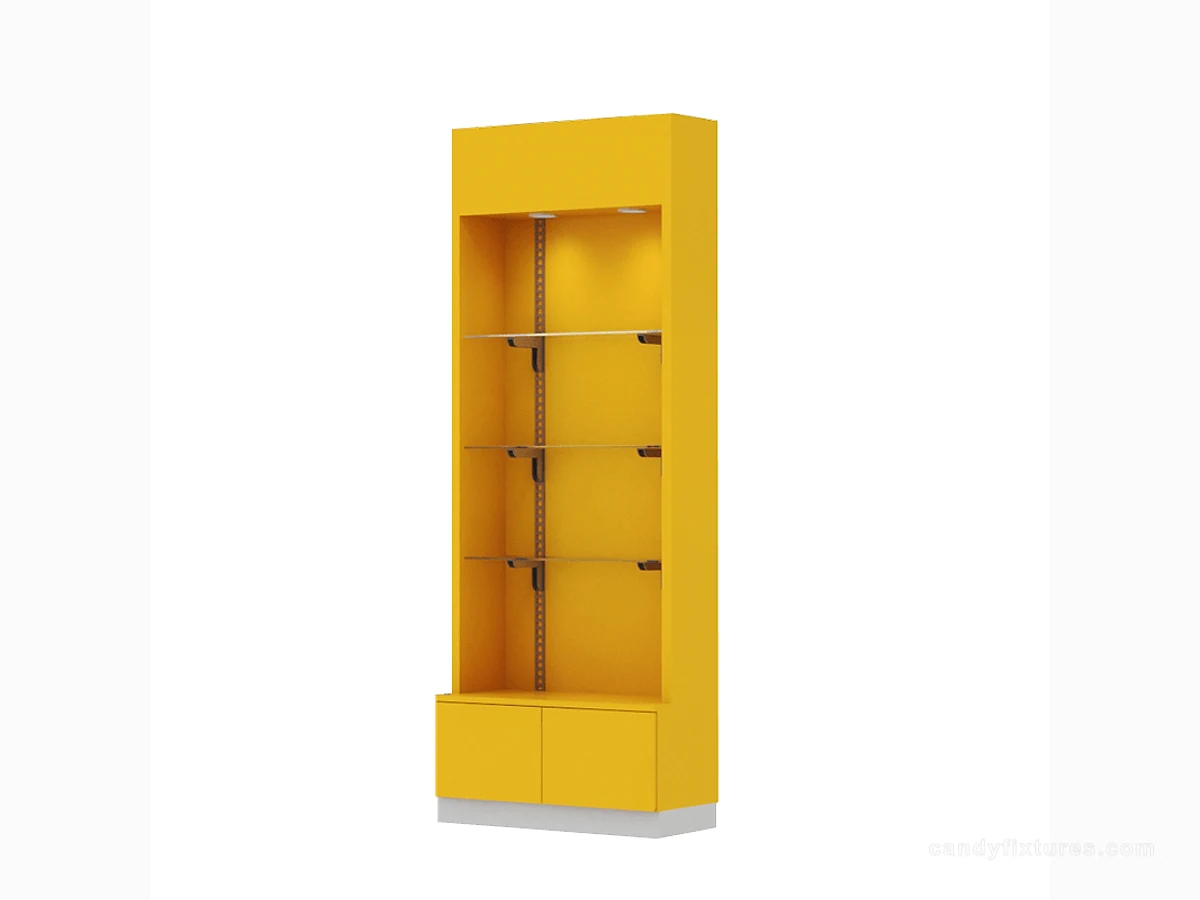
Give the trial a defined footprint. A shelf section, a small table or a counter zone is easier to reconcile than scattered discounted packages throughout the shop. Choose a fixture that fits the actual packages and access tasks. A glass-panel shelf cabinet can help organize separate groups, while a display with base storage can keep approved reserve stock nearby. Confirm dimensions and the supplied configuration before purchasing; a photograph does not establish capacity or direct food-contact suitability.
Keep the offer readable from the shopping approach. Identify the eligible product and selling unit, and show the price shoppers will pay in a way consistent with applicable local pricing requirements. Do not cover ingredient, allergen, date or other necessary product information with a promotional sticker. Confirm any comparison or saving claim against the relevant requirements and actual price records. Do not invent a former price to create a larger-looking saving.
Avoid making the clearance zone a barrier to ordinary shopping. Staff should be able to replenish the stock and customers should be able to approach it without moving other fixtures. Check the arrangement with real packages, including the largest eligible box. Keep the checkout work area available for ordinary service. If a promotion repeatedly requires staff to move products just to reach packaging or payment equipment, reduce its footprint or choose a different location.
Rehearse checkout and launch a controlled trial
Before the offer opens, select a real eligible item and verify the shelf statement, checkout entry and receipt agree. Then test a similar excluded item so the boundary works in both directions. Check any multi-item condition using the actual eligible combination. Record the observed result and who checked it. If the system cannot represent the intended offer clearly, simplify the offer or postpone it until the discrepancy is resolved.
Brief staff on the purpose, eligible products, selling unit, effective period and exception route. Explain what to do if a customer brings an older sign, asks about an excluded variant or finds conflicting information. Use the shop's approved customer-service process and obtain appropriate advice where obligations need interpretation. Staff should not improvise a new markdown policy in the middle of a queue. A concise written instruction reduces contradictory answers between shifts.
Set a trial review point that matches the actual selling opportunity. Do not promise a particular sales increase or assume that a deeper discount will always recover more value. Track the eligible quantity sold, the amount received and any additional handling work that the business can reliably measure. Also note whether full-price products were displaced from a useful display location. Those observations make the review more useful than a single total-sales figure.
Review recovery and stop the wrong experiment
Compare the ending eligible quantity with the beginning count, additions, sales and documented removals. Investigate discrepancies before calling the promotion successful. A smaller pile is not necessarily evidence of sales if packages were transferred elsewhere or removed because of a product issue. Separate recorded sales from stock adjustments. Keep the calculation simple enough that another member of staff can reproduce it from the same supporting records.
For an illustrative worksheet, suppose 40 eligible packs begin the trial and 12 sell at a reduced price of 3 currency units each. Recorded revenue is 12 multiplied by 3, or 36 currency units, before considering taxes, product costs or other expenses. The unsold eligible quantity is 28 only if there were no additions or other removals. This is an arithmetic example, not a recommended price, expected result or statement of profit. Use consistent units and verified inputs.
Stop or revise the trial if price confusion persists, excluded products repeatedly enter the display, the stock condition becomes uncertain or the promotion obstructs service. Escalate the relevant problem rather than applying a larger reduction automatically. If sales remain weak after a clear trial, consider whether assortment, timing or package suitability is the real issue. A markdown is one operating option, not a reason to keep purchasing a range that lacks a defined role.
Close the offer and feed the next buying decision
Assign the closing task as carefully as the launch. Remove expired signs, restore or change checkout prices as authorized, and recount remaining eligible goods. Record the destination of unsold stock through the shop's normal process. Do not quietly mix it back into regular displays if its identity or conditions differ. Confirm that the list of active offers matches what shoppers can see after the shift changes.
Keep the approval, starting count, price-change evidence, sales record and closing note together. The IRS explains that business transactions generate supporting documents used in recordkeeping; its guidance concerns US records and is not a markdown policy. Ask the appropriate adviser about requirements for your business. Retain enough detail to distinguish a commercial price reduction from inventory loss, a product withdrawal or an ordinary stock transfer.
Finish with a buying recommendation supported by the trial. The answer might be a smaller initial seasonal order, clearer packaging selection, a different display footprint or no change because the observation period was too limited. Record what remains uncertain. For the next range review, compare that recommendation with the actual customer and stock evidence. A useful clearance trial improves the next decision instead of becoming a recurring last-minute discount on the same unsuitable quantity.
Related products and planning pages
Yellow Shelf Cabinet with Clear PanelsWhite L-Shaped Checkout CounterLayered Candy Gift Display with Base Storage Yellow Framed Display with Oval OpeningCandy Store Waste Tracking: Turn Loss Records into a Display DecisionContinue with this complementary operating guide.Candy Stock Rotation: Keep Product Identity through Refill and CleaningContinue with this complementary operating guide.Candy Store Price Tags: Keep the Selling Unit ObviousContinue with this complementary operating guide.Candy Store FixturesCompare display, counter and storage arrangements.
Frequently asked questions
Should every slow-selling candy receive a discount?
No. Check stock availability, display visibility, package fit and price clarity first. A markdown trial should address a specific eligible stock problem.
What discount percentage should a candy shop use?
There is no universal percentage. Use verified costs, the commercial objective and appropriate advice, then define the exact products and offer period.
Can markdown stock be mixed with the regular range?
Only when the offer boundary remains clear. Separate similar excluded variants and test the checkout rules before launch.
When should a trial stop?
Use the agreed review point and stop earlier if product conditions become uncertain, price confusion persists or the display disrupts service. Record the outcome and remaining quantity.
Sources and further reading
- SBA — Manage your businessUS official background on bookkeeping and cost-benefit analysis; not a prescribed markdown rate.
- IRS — RecordkeepingUS supporting-document guidance; confirm the requirements applicable to your business.
Use the linked material as background. The accepted product information, equipment instructions and requirements applicable to your location determine the final operating and installation decisions.